Anxiety in Times of War: What Do Young Adults Need to Know and How to Manage it?

By Rawane Rawda El Balah
LD, MSc Human Nutrition | Saint Joseph University
Armed conflict has profound effects on mental health, particularly among young adults navigating academic, social, and personal challenges. In contexts of instability, such as ongoing bombardments and forced displacement, stress levels can intensify significantly.
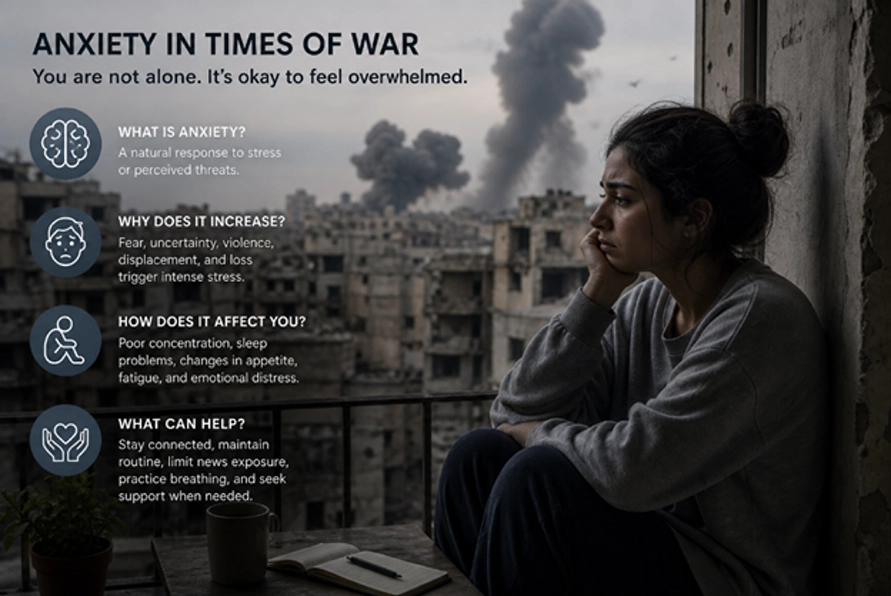
What is anxiety, and why does it increase during war?
Anxiety is a natural psychological response to perceived threats, characterized by excessive worry, restlessness, and difficulty concentrating. War-related stressors such as uncertainty about the future, fear for personal safety, exposure to violence, even indirect exposure such as continuous media coverage, can contribute to sustained activation of stress-response systems.
How does anxiety affect daily functioning and lifestyle behaviors?
Anxiety during war extends beyond emotional distress, it significantly affects daily functioning and health-related behaviors. Recent study conducted among Lebanese university students during armed conflict showed that anxiety is associated with war-related stressors, such as:
- Experiencing bombardments
- Being forced to leave home
- Difficulty concentrating during online classes, affecting academic performance
- Changes in appetite, ranging from reduced intake to increased, it may reflect emotional coping mechanisms, which, over time, can negatively impact nutritional status and overall health
- Reduced engagement in physical activity
In addition, increased screen time, particularly exposure to war-related content on social media, has been associated with higher levels of anxiety and emotional exhaustion. It may also contribute to reduced attention span and sleep disturbances, particularly when exposure occurs late at night.
What can young adults do to better manage anxiety during conflict?
While anxiety in such contexts is a normal response, adopting structured coping strategies can help reduce its impact.
- Maintain a daily routine: Even in unstable conditions, regular sleep and meal timing can support psychological stability
- Engaging in physical activity: Movement, even light activity, can help regulate stress response
- Managing media exposure: Limiting constant exposure to distressing news can reduce emotional overload
- Staying socially connected: Communication with peers and family strengthens emotional resilience
- Seeking professional support when needed: Mental health services can play a critical role in managing persistent anxiety
These strategies aim to enhance coping capacity rather than eliminate stress, which is particularly important in conflict settings.
In conclusion, anxiety during armed conflict is a significant public health concern among young adults. Understanding these impacts and promoting adaptive coping strategies are essential for supporting resilience and health in conflict-affected populations.
References:
- El Balah RR, Sayegh NF, Hajj AE, El Helou N, Papazian T. Anxiety and lifestyle behaviors among Lebanese young adults during armed conflict: a cross-sectional study. BMC Public Health. 2026.
- Zhang SX, Li LZ. War anxiety: a review. Curr Psychiatry Rep. 2025;27(2):140–146.
- Amsalem D, Haim-Nachum S, Lazarov A, Levi-Belz Y, Markowitz JC, Bergman M, et al. The effects of war-related experiences on mental health symptoms of individuals living in conflict zones: a longitudinal study. Sci Rep. 2025;15:889.
- Yacoub L, Elhajjar S, Al Maalouf N. The impact of social media exposure to war content on emotional exhaustion and anxiety. Acta Psychol (Amst). 2026.